The Human Eye and the Colourful World Class 10 Physics Questions & Answers
मानव नेत्र तथा रंगबिरंगा संसार
Bihar Board/NCERT Class 10 Physics, Chapter 11: objective (MCQ) and subjective (short and long answer) questions with answers.
41
Question 41
Rainbow effect is the result of _____________.
इंद्रधनुष प्रभाव _____________ का परिणाम है।
a
Reflection of light
प्रकाश का परावर्तन
b
Refraction of light
प्रकाश का अपवर्तन
c
Dispersion of light
प्रकाश का वर्ण विक्षेपण
d
Scattering of light
प्रकाश का प्रकीर्णन
Ans english:-
The rainbow effect is caused by the dispersion of light. When sunlight passes through raindrops, it is refracted and split into its constituent colours. Different colours bend by different amounts due to their different wavelengths, producing the beautiful spectrum of colours seen in a rainbow.
Ans hindi:-
इंद्रधनुष प्रभावप्रकाश के वर्ण विक्षेपण (Dispersion of Light) के कारण उत्पन्न होता है। जब सूर्य का प्रकाश वर्षा की बूंदों से होकर गुजरता है, तो उसका अपवर्तन होता है और वह अपने घटक रंगों में विभाजित हो जाता है। विभिन्न तरंगदैर्ध्यों के कारण प्रत्येक रंग अलग-अलग मात्रा में मुड़ता है, जिससे इंद्रधनुष के सुंदर रंग दिखाई देते हैं।
Tap an option to reveal the answer
42
Question 42
A rainbow is caused by _________.
इंद्रधनुष _________ के कारण बनता है।
a
Reflection of sunlight by clouds
बादलों द्वारा सूर्य प्रकाश का परावर्तन
b
Dispersion of sunlight by tiny water droplets present in the atmosphere
वायुमंडल में उपस्थित छोटी जल बूँदों द्वारा सूर्य प्रकाश का विक्षेपण
c
Scattering of sunlight by dust particles
धूल के कणों द्वारा सूर्य प्रकाश का प्रकीर्णन
d
Absorption of sunlight by water vapour
जलवाष्प द्वारा सूर्य प्रकाश का अवशोषण
Ans english:-
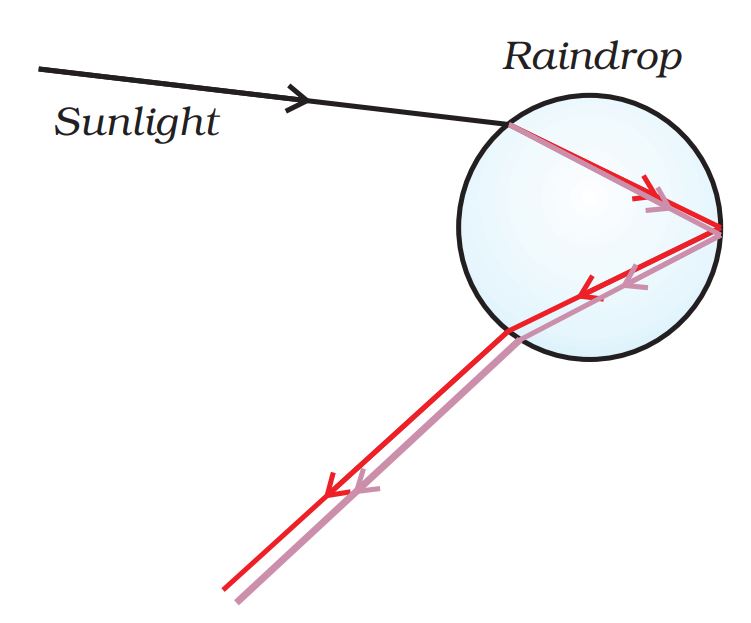
A rainbow is a natural spectrum appearing in the sky after a rain shower. It is caused by dispersion of sunlight by tiny water droplets present in the atmosphere. The water droplets act like small prisms — they refract and disperse the incident sunlight, then reflect it internally, and finally refract it again when it comes out of the raindrop. A rainbow is always formed in a direction opposite to that of the Sun.
Ans hindi:-
इंद्रधनुष वर्षा के बाद आकाश में दिखाई देने वाला एक प्राकृतिक वर्णक्रम है। यह वायुमंडल में उपस्थित छोटी जल बूँदों द्वारा सूर्य प्रकाश के विक्षेपण के कारण बनता है। जल की बूँदें छोटे प्रिज़्म की तरह काम करती हैं — ये आपतित सूर्य प्रकाश को अपवर्तित और विक्षेपित करती हैं, फिर इसे आंतरिक रूप से परावर्तित करती हैं, और अंत में जब यह वर्षा की बूँद से बाहर निकलता है तो पुनः अपवर्तित होता है। इंद्रधनुष हमेशा सूर्य की विपरीत दिशा में बनता है।
Tap an option to reveal the answer
43
Question 43
In which direction is a rainbow always formed with respect to the Sun?
इंद्रधनुष सूर्य की किस दिशा में बनता है?
a
In the same direction as the Sun
सूर्य की उसी दिशा में
b
Perpendicular to the direction of the Sun
सूर्य की दिशा के लंबवत
c
In the direction opposite to that of the Sun
सूर्य की विपरीत दिशा में
d
Always in the East
हमेशा पूर्व में
Ans english:-
A rainbow is always formed in a direction opposite to that of the Sun. This is why we see a rainbow in the east during the morning (when the Sun is in the west) and in the west during the evening (when the Sun is in the east). The observer must have the Sun behind them to see a rainbow.
Ans hindi:-
इंद्रधनुष हमेशा सूर्य की विपरीत दिशा में बनता है। इसीलिए हम सुबह पूर्व में इंद्रधनुष देखते हैं (जब सूर्य पश्चिम में होता है) और शाम को पश्चिम में (जब सूर्य पूर्व में होता है)। इंद्रधनुष देखने के लिए दर्शक की पीठ सूर्य की ओर होनी चाहिए।
Tap an option to reveal the answer
44
Question 44
In case of rainbow, the water droplets act like ____________.
इंद्रधनुष के संदर्भ मे, जल की बूंदें ____________ की तरह कार्य करती हैं।
a
Plane mirrors
समतल दर्पण
b
Convex lenses
उत्तल लेंस
c
Small prisms
छोटे प्रिज्म
d
Concave mirrors
अवतल दर्पण
Ans english:-
Water droplets in the atmosphere act like small prisms. They refract, disperse, and internally reflect sunlight, separating it into its constituent colours and producing a rainbow.
Ans hindi:-
वायुमंडल में उपस्थित जल की बूंदें छोटे प्रिज्मों की तरह कार्य करती हैं। वे सूर्य के प्रकाश का अपवर्तन, वर्ण-विक्षेपण तथा आंतरिक परावर्तन करती हैं, जिससे प्रकाश अपने घटक रंगों में विभाजित होकर इंद्रधनुष बनाता है।
Tap an option to reveal the answer
45
Question 45
What role do water droplets play in the formation of a rainbow?
इंद्रधनुष के निर्माण में जल की बूँदें क्या भूमिका निभाती हैं?
a
They only reflect sunlight
वे केवल सूर्य के प्रकाश को परावर्तित करती हैं
b
They refract, disperse, internally reflect, and again refract sunlight
वे सूर्य के प्रकाश को अपवर्तित, विक्षेपित, आंतरिक रूप से परावर्तित और पुनः अपवर्तित करती हैं
c
They only scatter sunlight
वे केवल सूर्य के प्रकाश को प्रकीर्णित करती हैं
d
They absorb all colours and re-emit them separately
वे सभी रंगों को अवशोषित करके उन्हें अलग-अलग पुनः उत्सर्जित करती हैं
Ans english:-
Water droplets act like small prisms. They refract and disperse the incident sunlight as it enters the droplet, then reflect it internally, and finally refract it again when it comes out of the raindrop. This sequence of refraction → dispersion → internal reflection → refraction produces the spectrum of colours seen in a rainbow.
Ans hindi:-
जल की बूँदें छोटे प्रिज़्म की तरह कार्य करती हैं। जब सूर्य का प्रकाश बूँद में प्रवेश करता है तो वे उसे अपवर्तित और विक्षेपित करती हैं, फिर उसे आंतरिक रूप से परावर्तित करती हैं, और अंत में जब प्रकाश वर्षा की बूँद से बाहर निकलता है तो उसे पुनः अपवर्तित करती हैं। अपवर्तन → विक्षेपण → आंतरिक परावर्तन → अपवर्तन का यह क्रम इंद्रधनुष में दिखने वाले रंगों का वर्णक्रम उत्पन्न करता है।
Tap an option to reveal the answer
46
Question 46
The twinkling of a star is due to _________.
तारों का टिमटिमाना _________ के कारण होता है।
a
Dispersion of starlight
तारों के प्रकाश का विक्षेपण
b
Scattering of starlight by dust particles
धूल के कणों द्वारा तारों के प्रकाश का प्रकीर्णन
c
Atmospheric refraction of starlight
तारों के प्रकाश का वायुमंडलीय अपवर्तन
d
Reflection of starlight by clouds
बादलों द्वारा तारों के प्रकाश का परावर्तन
Ans english:-
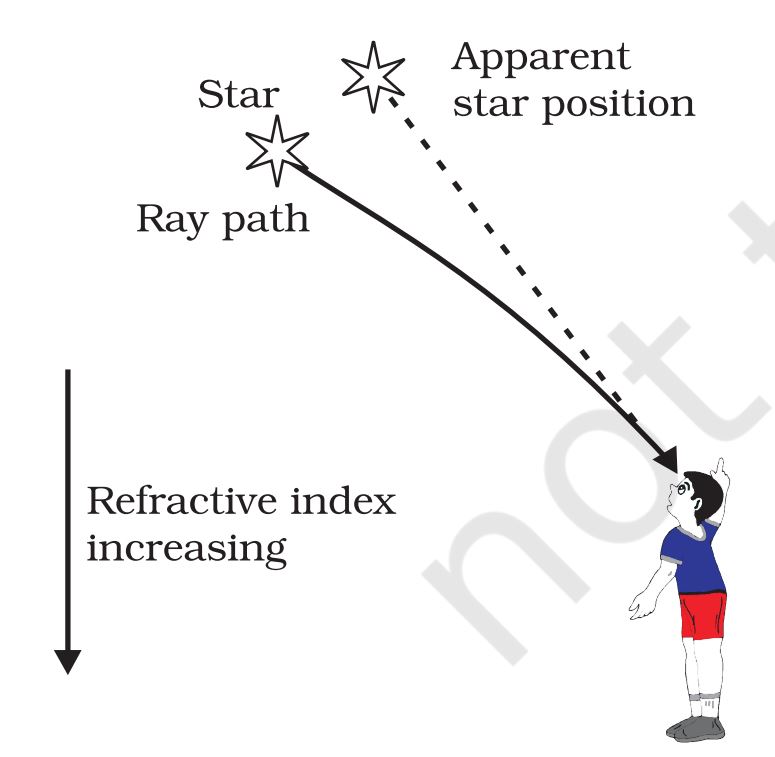
The twinkling of a star is due to atmospheric refraction of starlight. As starlight passes through the Earth's atmosphere, it undergoes continuous refraction due to the changing refractive index of the atmospheric layers. This causes the apparent position of the star to slightly shift, making it appear to twinkle. Planets do not twinkle because they appear as extended sources and the fluctuations average out.
Ans hindi:-
तारों का टिमटिमाना तारों के प्रकाश के वायुमंडलीय अपवर्तन के कारण होता है। जब तारों का प्रकाश पृथ्वी के वायुमंडल से होकर गुज़रता है, तो यह वायुमंडलीय परतों के बदलते अपवर्तनांक के कारण लगातार अपवर्तित होता है। इससे तारे की आभासी स्थिति थोड़ी बदलती रहती है जिससे वह टिमटिमाता प्रतीत होता है। ग्रह टिमटिमाते नहीं क्योंकि वे विस्तारित स्रोत की तरह दिखते हैं और उतार-चढ़ाव औसत हो जाते हैं।
Tap an option to reveal the answer
47
Question 47
When viewed near the horizon, a star appears _________ its actual position due to atmospheric refraction.
वायुमंडलीय अपवर्तन के कारण क्षितिज के पास देखने पर तारा अपनी वास्तविक स्थिति से _________ दिखाई देता है।
a
Slightly lower than
थोड़ा नीचे
b
Slightly higher (above) than
थोड़ा ऊपर
c
To the left of
बाईं ओर
d
At exactly
बिल्कुल उसी स्थान पर
Ans english:-
Due to atmospheric refraction, a star appears slightly higher (above) than its actual position when viewed near the horizon. This is because the starlight bends towards the normal as it travels from the less dense upper atmosphere to the denser lower atmosphere, making the star appear at a slightly raised position.
Ans hindi:-
वायुमंडलीय अपवर्तन के कारण क्षितिज के पास देखने पर तारा अपनी वास्तविक स्थिति से थोड़ा ऊपर दिखाई देता है। ऐसा इसलिए होता है क्योंकि तारे का प्रकाश कम सघन ऊपरी वायुमंडल से अधिक सघन निचले वायुमंडल में जाते समय अभिलम्ब की ओर झुकता है, जिससे तारा थोड़ी ऊँची स्थिति पर दिखाई देता है।
Tap an option to reveal the answer
48
Question 48
Due to atmospheric refraction, the Sun is visible approximately how many minutes before actual sunrise and after actual sunset?
वायुमंडलीय अपवर्तन के कारण सूर्य वास्तविक सूर्योदय से लगभग कितने मिनट पहले और वास्तविक सूर्यास्त के कितने मिनट बाद दिखाई देता है?
a
5 minutes
5 मिनट
b
10 minutes
10 मिनट
c
2 minutes
2 मिनट
d
30 minutes
30 मिनट
Ans english:-
Due to atmospheric refraction, the Sun is visible to us about 2 minutes before the actual sunrise and about 2 minutes after the actual sunset. The light from the Sun bends towards the Earth as it passes through the atmosphere, making the Sun appear above the horizon even when it is actually just below it. This increases the duration of daylight by approximately 4 minutes per day.
Ans hindi:-
वायुमंडलीय अपवर्तन के कारण सूर्य हमें वास्तविक सूर्योदय से लगभग 2 मिनट पहले और वास्तविक सूर्यास्त के लगभग 2 मिनट बाद तक दिखाई देता है। सूर्य का प्रकाश वायुमंडल से गुज़रते समय पृथ्वी की ओर झुकता है, जिससे सूर्य क्षितिज के ऊपर दिखाई देता है जबकि वास्तव में वह उसके ठीक नीचे होता है। इससे दिन की अवधि प्रतिदिन लगभग 4 मिनट बढ़ जाती है।
Tap an option to reveal the answer
49
Question 49
The blue colour of the sky, colour of water in deep sea, the reddening of the Sun at sunrise and sunset are all due to _________.
आकाश का नीला रंग, गहरे समुद्र के जल का रंग, सूर्योदय और सूर्यास्त के समय सूर्य का लाल होना — ये सभी _________ के कारण हैं।
a
Dispersion of light
प्रकाश का वर्ण विक्षेपण
b
Reflection of light
प्रकाश का परावर्तन
c
Scattering of light
प्रकाश का प्रकीर्णन
d
Refraction of light
प्रकाश का अपवर्तन
Ans english:-
The blue colour of the sky, the colour of water in deep sea, and the reddening of the Sun at sunrise and sunset are all due to scattering of light. Fine particles in the atmosphere scatter shorter wavelengths (blue) more than longer wavelengths (red). At sunrise/sunset, sunlight travels a longer path through the atmosphere, so most blue light is scattered away, leaving the red and orange colours to reach our eyes.
Ans hindi:-
आकाश का नीला रंग, गहरे समुद्र के जल का रंग और सूर्योदय व सूर्यास्त के समय सूर्य का लाल दिखना — ये सभी प्रकाश के प्रकीर्णन के कारण होते हैं। वायुमंडल में सूक्ष्म कण लंबी तरंगदैर्ध्य (लाल) की तुलना में छोटी तरंगदैर्ध्य (नीला) को अधिक प्रकीर्णित करते हैं। सूर्योदय/सूर्यास्त के समय सूर्य प्रकाश वायुमंडल में अधिक लंबा पथ तय करता है, इसलिए अधिकांश नीला प्रकाश प्रकीर्णित हो जाता है और लाल व नारंगी रंग हमारी आँखों तक पहुँचते हैं।
Tap an option to reveal the answer
50
Question 50
Why is the sky blue?
आकाश नीला क्यों दिखाई देता है?
a
Because the atmosphere absorbs all colours except blue
क्योंकि वायुमंडल नीले को छोड़कर सभी रंगों को अवशोषित कर लेता है
b
Because fine particles in air scatter blue light (shorter wavelength) more strongly than red
क्योंकि वायु में सूक्ष्म कण नीले प्रकाश (कम तरंगदैर्ध्य) को लाल की अपेक्षा अधिक प्रबलता से प्रकीर्णित करते हैं
c
Because the ocean reflects blue colour into the sky
क्योंकि महासागर नीले रंग को आकाश में परावर्तित करता है
d
Because blue light travels faster than other colours in the atmosphere
क्योंकि नीला प्रकाश वायुमंडल में अन्य रंगों की तुलना में तेज़ गति से चलता है
Ans english:-
When sunlight passes through the atmosphere, fine particles in air scatter the blue colour (shorter wavelengths) more strongly than red. The red light has a wavelength about 1.8 times greater than blue light, so it is scattered much less. The scattered blue light reaches our eyes from all parts of the sky, making the sky appear blue. If the Earth had no atmosphere, there would be no scattering and the sky would appear dark (black).
Ans hindi:-
जब सूर्य प्रकाश वायुमंडल से होकर गुज़रता है, तो वायु में सूक्ष्म कण नीले प्रकाश (कम तरंगदैर्ध्य) को लाल की अपेक्षा अधिक प्रबलता से प्रकीर्णित करते हैं। लाल प्रकाश की तरंगदैर्ध्य नीले प्रकाश की लगभग 1.8 गुना अधिक होती है, इसलिए यह बहुत कम प्रकीर्णित होता है। प्रकीर्णित नीला प्रकाश आकाश के सभी भागों से हमारी आँखों तक पहुँचता है जिससे आकाश नीला दिखाई देता है। यदि पृथ्वी पर कोई वायुमंडल नहीं होता, तो कोई प्रकीर्णन नहीं होता और आकाश अँधेरा (काला) दिखाई देता।